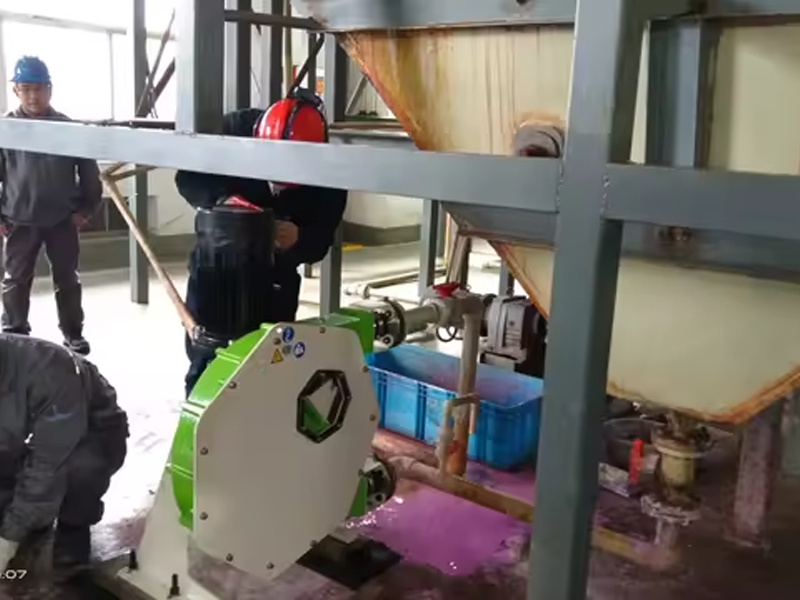








Application of Hose Pumps in Chemical Plants
During chemical production processes, it is often necessary to handle complex media that are corrosive, abrasive, highly viscous, or contain solid particles. When transporting such media, conventional pumps may experience corrosion or wear of mechanical seals, valves, and metallic wetted components, increasing the risk of leakage and maintenance costs. Hose pumps operate on a squeezing principle, keeping the pumped medium completely enclosed within the hose. This helps minimize the impact of the medium on critical pump components and makes hose pumps suitable for a wide range of demanding chemical applications.
In chemical production, hose pumps can be used for raw material transfer, chemical transfer, process dosing, slurry circulation, feeding filtration equipment, and product filling. Their excellent self-priming capability and reversible operation also allow them to adapt to changing tank levels, pipeline draining, and varying on-site operating conditions.
Typical Applications:
-
Transfer of acids, alkalis, and corrosive chemicals
-
Transfer of resins, polymers, and adhesives
-
Transfer of titanium dioxide, pigments, and coating slurries
-
Transfer of lime slurry and high-solids slurries
-
Transfer of chemical solutions and additives
-
Chemical raw material transfer
-
Precise dosing during production processes
-
Feeding filtration equipment and filter presses
-
Transfer of high-viscosity and particle-laden media
For different chemical media, the hose material should be selected according to the medium composition, concentration, temperature, pressure, and operating cycle frequency. No single hose material is suitable for all chemicals.